Raid: Shadow Legends, explained plainly
This page is advertising-funded and contains partner links. Every button on this page marked “partner link” is a commercial link. If you install or sign up through one, Branch line 005 s.r.o. receives a commission from the advertiser. You are never charged more for using it, and you can reach the game directly through the App Store or Google Play without using our link at all.
Commission does not buy coverage. Nothing in this article is written, reviewed or approved by the advertiser, and the critical parts below — including the section on spending — are there precisely because they would not be. Read the editorial policy if you want to know how we separate the two.
Not affiliated. zlatomir.online is independent and is not affiliated with, endorsed by or sponsored by Plarium, Aristocrat Leisure, Apple or Google.
Raid: Shadow Legends has been advertised more heavily than almost any mobile game of its generation, which means an enormous number of people have heard the name and very few have been told how the game actually works. This guide is the explanation: the real mechanics, the real economy, what it costs, and an honest answer to the question everybody asks about it.
It is written for someone deciding whether to install it — or whether to let a teenager install it — rather than for an existing player hunting a specific build. Where something is genuinely uncertain, or changes with every update, we say so rather than inventing a number. The illustrations on this page are original diagrams drawn for this article; there are no product screenshots here.
What the game actually is
Raid: Shadow Legends is a free-to-download, turn-based collection role-playing game published by Plarium, a development studio owned by the Australian gaming group Aristocrat Leisure. It was released for iOS and Android in 2018, and later became playable on Windows through Plarium's own desktop client using the same account.
“Collection RPG” is the important half of that description. You do not control a single hero who grows through a story. You assemble a roster of characters — the game calls them champions — that you acquire largely at random, and the game is about which four of them you put together, how you equip them, and in what order they act. The dark-fantasy setting, Teleria, is the wrapper. The collecting and the team-building are the game.
Two practical consequences follow immediately, and they are the two things most new players are not told: the game requires a permanent internet connection, and your progress is gated far less by skill than by time and randomness. We will come back to both.
How a fight works
A battle puts a team of champions — usually four, though the limit differs by mode — against a computer-controlled or player-built opposing team. Combat is turn-based: nobody moves in real time, and you choose which skill each of your champions uses when its turn arrives.
Turn order is a statistic, not a queue
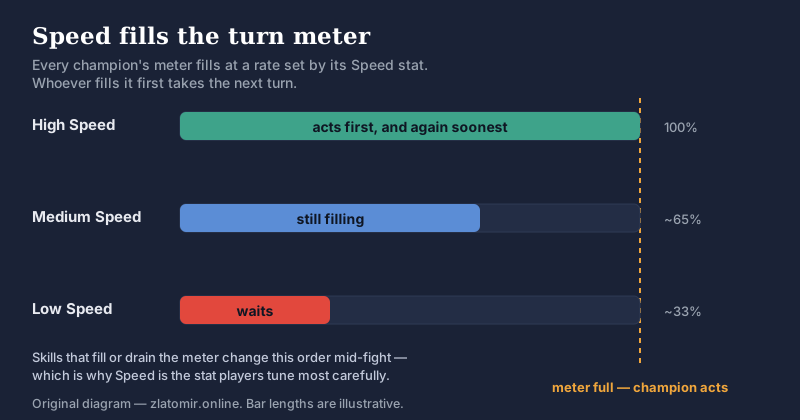
Turn order is not fixed at the start of a fight. Every champion has a hidden turn meter that fills continuously during the battle, at a rate set by its Speed statistic. When a champion's meter fills, it takes a turn and the meter empties. A faster champion therefore acts sooner and acts more often.
This is why Speed is the statistic experienced players obsess over. It is also why a great many skills in the game do nothing but push a turn meter forward or drag an enemy's backwards: manipulating the order of turns is frequently more powerful than raw damage.
Affinity: a rock-paper-scissors layer
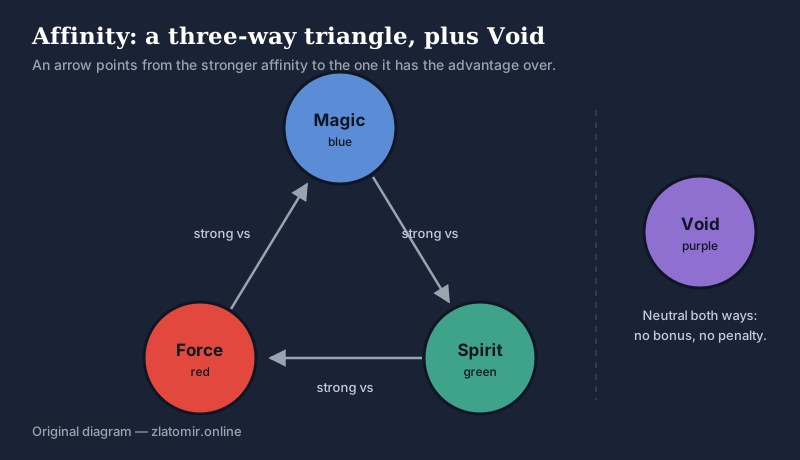
Every champion, and every enemy, belongs to one of four affinities: Magic, Force, Spirit and Void. Three of them form a cycle — Magic has the advantage over Spirit, Spirit over Force, and Force over Magic. Void sits outside the cycle entirely: it has neither an advantage nor a disadvantage against anything.
Attacking with the advantage improves your chances of a critical hit. Attacking into a disadvantage can produce a weak hit, which does reduced damage and can cause debuffs to fail to land — the single most common reason a new player's team loses a fight it looked capable of winning. Much of the game's content is built around specific affinities, which is why a roster of nothing but one colour runs into walls.
Skills, cooldowns and masteries
Each champion has a small set of active skills, most of them on cooldowns of a few turns, plus in many cases a passive. Skills can be upgraded with consumable skill books, which usually shorten cooldowns or raise effect chances; books for the rarest champions are themselves a scarce resource.
On top of that sits a separate mastery system: three trees, broadly offensive, defensive and supportive, unlocked with scrolls earned from play. Masteries are a meaningful power increase and cost no money, but they take time to accumulate.
Want to look at it yourself?
The game is free to download. You can also reach it directly through the App Store or Google Play without using our link.
See Raid: Shadow Legends on the official storePartner link — advertisement We earn a commission if you sign up through this link. It costs you nothing extra and does not change what we write.Champions, rarity and rank
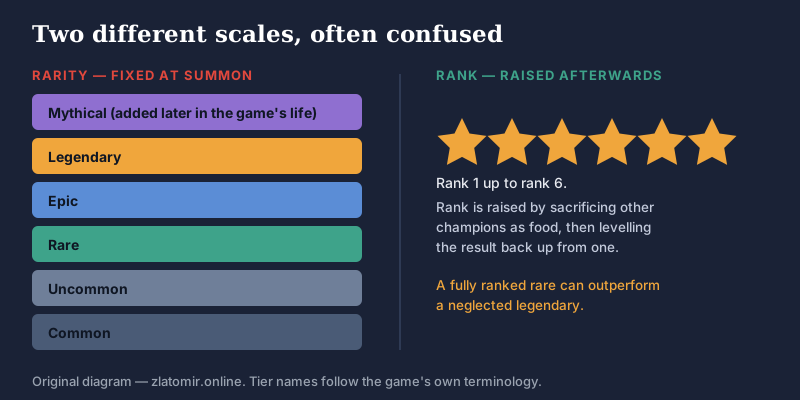
Two different scales govern a champion, and new players conflate them constantly.
Rarity is fixed the moment a champion is summoned and can never be changed: Common, Uncommon, Rare, Epic and Legendary, with a Mythical tier added later in the game's life. Rarity sets a champion's ceiling.
Rank is the star count, from one to six, and you raise it yourself after the fact by sacrificing other champions as material. Ascending a rank resets the champion to level one and raises the maximum level it can reach. Rank is where most of a champion's realised power comes from, and it is entirely a function of grinding.
The practical upshot is worth stating bluntly, because it contradicts how the game is usually marketed: a fully ranked, well-equipped Rare champion will comfortably out-perform a Legendary you pulled and then neglected. Pulling a rare champion is the start of a long investment, not a result.
Champions are also sorted into factions, and some content — Faction Wars in particular — requires a team drawn from a single faction. This quietly makes breadth valuable: a roster that is deep in one faction and empty in another will stall.
Gear: the real bottleneck
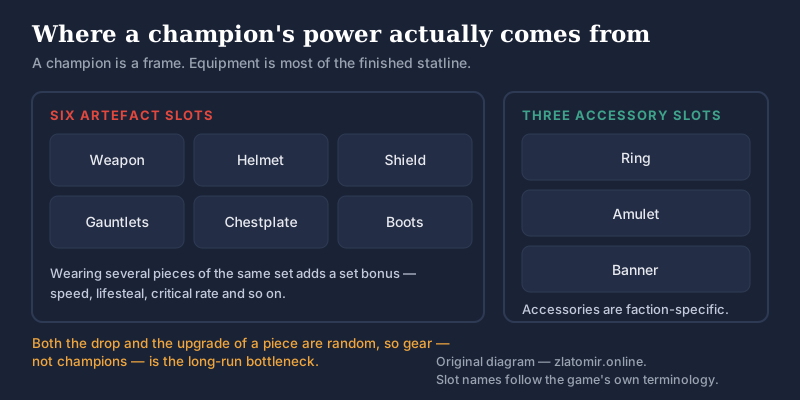
A champion is a frame. The statline you actually fight with is mostly equipment.
Each champion has six artefact slots — weapon, helmet, shield, gauntlets, chestplate, boots — and three accessory slots for a ring, an amulet and a banner. Accessories are faction-specific. Artefacts come in sets, and wearing several pieces of the same set adds a set bonus, such as increased Speed, lifesteal or critical rate.
Here is the part that decides how long you will be playing. Each piece has a main statistic and up to four secondary statistics, and both the piece you find and the statistics it gains when you upgrade it are random. Upgrading costs silver, and a failed or badly-rolled upgrade is simply money burned. Gear drops from dungeons, which cost energy, which is finite.
For most accounts past the first few weeks, the limiting factor is not which champions you own. It is whether you have six pieces of good gear to put on them. Any guide that tells you the game is about collecting champions has skipped the part you will actually spend your time on.
Summoning is a randomised draw
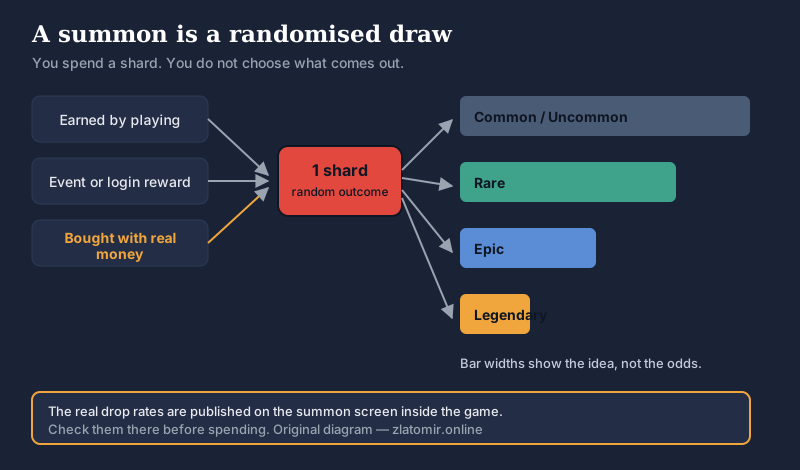
New champions arrive through summoning. You spend a shard and receive a champion determined by chance. The set of shard types has grown over the game's life; different shards draw from different pools and offer different odds of a high-rarity result.
Three things about this are worth being precise about, because marketing around games of this type frequently is not.
- You are buying a chance, never an outcome. Ten shards can produce ten champions you do not want. That is not bad luck in any special sense; it is the expected behaviour of the system.
- The odds are published inside the game, on the summoning screen, and they can differ between shard types and during events. We deliberately do not reprint percentages here: they change, and a stale number on a web page is worse than no number. Read them in the app before you spend.
- Shards are obtainable without paying — through play, quests, events and login rewards — but the rate at which you obtain them is one of the things money buys.
What there is to do
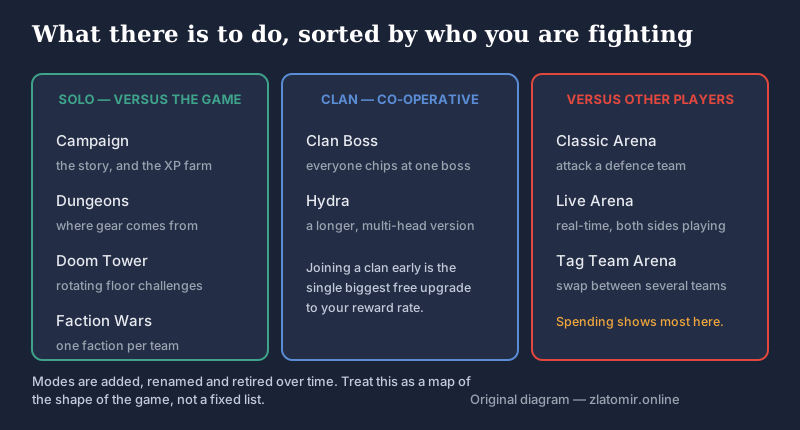
The activity list has grown considerably since launch, and it is regularly reorganised, but it falls into three groups.
| Group | Typical modes | What it is for |
|---|---|---|
| Solo, against the game | Campaign, dungeons, Doom Tower, Faction Wars | Experience, silver, gear and ascension materials. This is where most of your hours go. |
| Clan, co-operative | Clan Boss, Hydra | A shared damage target; rewards scale with the clan's collective result. Joining an active clan is the largest free upgrade available to a new account. |
| Against other players | Classic Arena, Live Arena, Tag Team Arena | Ranked competition. This is where differences in roster and gear quality show most sharply. |
Decide for yourself how the modes feel
Reading about a turn meter is not the same as watching one fill. The campaign's opening chapters cost nothing and take a few minutes.
Try Raid: Shadow Legends freePartner link — advertisement We earn a commission if you sign up through this link. It costs you nothing extra and does not change what we write.The loop and the energy economy
Strip away the presentation and the game is a single loop: spend energy, fight, collect resources, upgrade something, unlock harder content that costs more energy.
Energy is the governor on all of it. It refills slowly over real time, its maximum capacity rises as your account level does, and it can also be refilled instantly using the game's premium currency — which can be earned, and can also be bought. That single valve is where the shop meets the gameplay, and understanding it explains most of the game's design decisions.
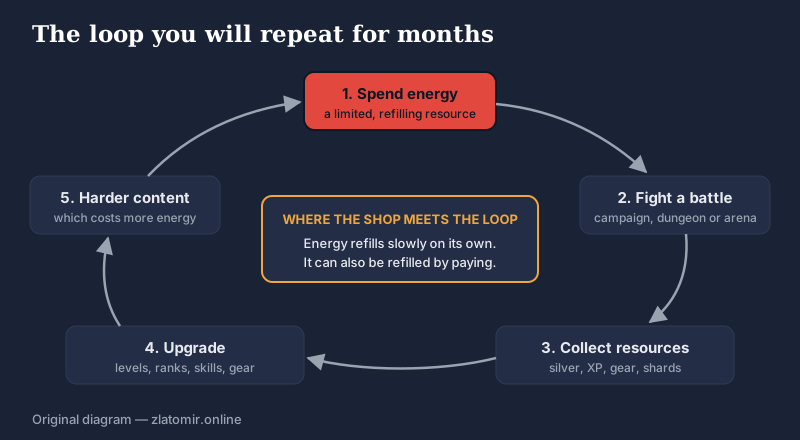
There is no ending. There is no point at which the game is finished. It is designed as an indefinite progression treadmill, and it is entirely reasonable to decide that is not what you want from your evenings.
What it costs, honestly
The download is free. Beyond that, the game sells premium currency, shard bundles, energy refills, time-limited offer packs and recurring progression passes. We are not going to quote prices: they differ by country and currency, they change constantly, and the store will show you the price including VAT before you confirm anything.
What is worth stating clearly is the structure of the spending, because that is stable even when prices are not:
- Almost all of it is randomised. You are buying draws, not champions.
- A great deal of it is time-limited, presented with a countdown. That urgency is a sales technique, not information about the game.
- There is no upper bound. Unlike a game you buy once, there is no point at which you have bought it all.
- Some of it is recurring. Subscriptions and passes renew unless you cancel them in your store account, not in the game.
If you take one thing from this page: decide what, if anything, you are willing to spend before you open the shop, and never decide it while an offer timer is counting down. See responsible play for the practical controls.
Is it pay-to-win?
This is the question the game's advertising has always been vaguest about, so here is a direct answer, split into the two halves it deserves.
In solo content, no — but slowly. A patient player who spends nothing can, over months, clear the great majority of the campaign, the dungeons and much of the endgame. The content is not locked behind a paywall. What money buys in this half of the game is time: more energy, more attempts, faster progress through the same material.
In competitive content, yes, materially. Ranked Arena and leaderboard events compare you directly against other players. There, a roster assembled from hundreds of summons and dressed in gear farmed with unlimited energy beats a roster that was not, and no amount of tactical skill closes that gap at the top of a ladder. Anyone telling you that the upper reaches of competitive play are decided by strategy rather than by investment is not describing this game.
The honest framing is that money does not buy a guaranteed outcome — the randomness is real, and large spenders miss too — but it buys far more chances, and over enough draws that is decisive.
A correction to earlier versions of this page. An earlier version of this article stated that in-game purchases “offer convenience rather than overwhelming power advantages” and that “skill and strategy matter more than spending money”. That was not an accurate description of a randomised-summon game with ranked competition, and it has been removed. See what we corrected.
Playing well without spending
If you do want to play and do not want to pay, the following actually matters more than any champion tier list.
- Join an active clan on day one. Clan rewards are free, substantial and continuous, and they are the single largest difference between two otherwise identical new accounts.
- Concentrate, do not spread. A small number of fully ranked, properly geared champions clears content that a wide roster of half-built ones cannot. Levelling material is your scarcest resource; do not spend it broadly.
- Farm experience deliberately. Players commonly grind a late campaign stage on a higher difficulty as a dedicated experience source rather than progressing aimlessly.
- Spend premium currency on permanent things. Account upgrades that persist are worth far more over a year than instant refills that are gone in ten minutes.
- Ignore most events. Events are designed so that completing them fully is uncomfortable without spending. Take the part you would have earned anyway and let the rest go.
- Treat gear as the project. Once you can farm dungeons reliably, the game becomes a gear-optimisation exercise. Accept that early and you will enjoy it more.
Starting as a free player
If you are going to try it, the advice above is worth applying from your first session rather than your fiftieth.
Start Raid: Shadow Legends freePartner link — advertisement We earn a commission if you sign up through this link. It costs you nothing extra and does not change what we write.Your rights, and staying in control
If you are playing from the European Union, a few things are worth knowing before you spend anything.
The 14-day withdrawal right usually will not help you. For digital content delivered immediately, the EU right of withdrawal is lost once performance has begun with your express consent and acknowledgement — which is exactly what happens when you buy in-game currency and receive it instantly. Refunds for in-app purchases are generally handled at the discretion of Apple or Google under their own store policies, and that is separate from, and additional to, your statutory rights against the trader.
Randomised in-game purchases are under active regulatory scrutiny. European consumer authorities have been examining virtual currencies and randomised rewards in games, including questions of price transparency and pressure selling. The rules in this area are still developing; if a purchase felt misleading to you, your national consumer authority is the place to raise it.
Age ratings and parental controls. The game carries an age rating on each store; check the current rating on the listing itself, since ratings are revised. If a child is playing, the controls that matter are not in the game — they are on the device and in the store account.
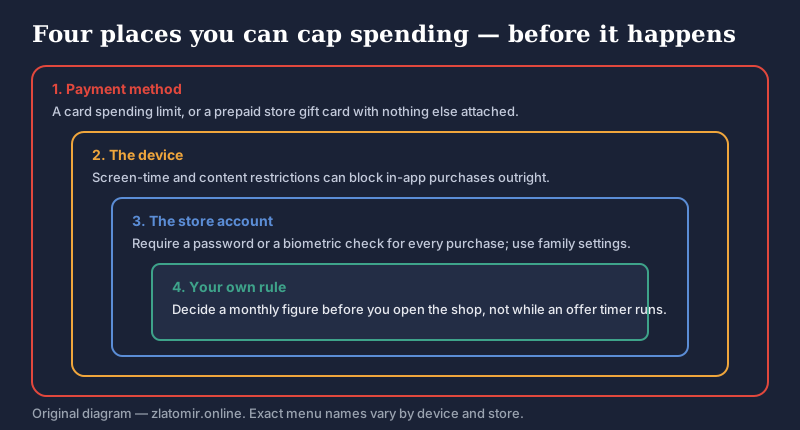
A fuller, practical version of this is on our responsible play page.
Devices, data and accounts
- Always online. There is no offline mode. A dropped connection during a long battle can cost you the attempt.
- It is a large install, and it grows with updates. Exact size depends on your device and the current version; the store listing shows the figure for your platform.
- It is demanding. Performance on older phones varies considerably. Graphics settings and battery consumption are worth checking before committing to it as your daily game.
- Bind your account. Linking to a Plarium account, or to your store account, is what lets you recover progress or move to a new device. Do it before you have anything to lose.
- Your data goes to the publisher, not to us. When you leave this page for the game, the publisher's own privacy policy governs what it collects. Ours, which describes collecting nothing, stops at our own site.
Who it suits — and who should skip it
It suits you if you enjoy optimisation for its own sake: building teams, tuning speed values, chasing a better piece of gear, and playing a little every day over a long period. The team-building puzzle is genuinely deep, and the turn-meter system gives it more texture than most games in the category.
Skip it if you want a story with an ending, if you dislike randomised rewards on principle, if you know that countdown timers and limited offers get to you, or if you are looking for a game you can finish. None of those are failures of taste. They are simply a mismatch with what this game is.
Where anything on this page diverges from the information published by the game's own publisher, or from what you see inside the app, the publisher's own information prevails. Game systems, prices, drop rates, modes and store listings change without notice, and this page is a snapshot reviewed on 22 September 2026.
If it sounds like your kind of game
Free to download, in-app purchases optional. Please read the spending section above first.
Download Raid: Shadow LegendsPartner link — advertisement We earn a commission if you sign up through this link. It costs you nothing extra and does not change what we write.What we corrected on this page
An earlier version of this article was promotional copy rather than a guide. In line with our corrections policy, here is what changed and why, rather than a silent rewrite.
| Previous claim | Why it was wrong | What it now says |
|---|---|---|
| “Unlike many free games that rely heavily on pay-to-win mechanics… skill and strategy matter more than spending money.” | Not supportable. The game is built on randomised summons and ranked competition in which roster and gear depth — both accelerated by spending — are decisive. | A split answer: solo content is completable without paying, competitive content is materially affected by it. See Is it pay-to-win? |
| “In-game purchases… offer convenience rather than overwhelming power advantages.” | Describes the monetisation inaccurately by omitting that purchases are randomised draws with no upper bound. | An explicit description of the spending structure, including the randomisation, the countdown offers and the recurring passes. |
| “Over 200 champions.” | A fixed figure for a roster that grows with nearly every update, and understated at the time of writing. | No count is given. The roster is described as large and growing, with the game itself as the reference. |
| “Millions worldwide” given as a player figure. | Presented as a fact without a source. Store download counts are not player counts. | Removed. The download count on each store listing is cited as the only figure a reader can check. |
| “This is a reader-submitted story”; the site described itself as “Reader Stories”. | The content was not reader-submitted. Presenting advertising copy as a reader's account is a fabricated testimonial. | Removed entirely. The article carries a named byline and an advertising label. |
| Site-wide cookie consent banner, and privacy and cookie policies describing analytics, advertising and affiliate cookies. | The policies described tracking that is no longer performed. | All collection removed. The cookie policy now states that nothing is stored, and explains how to verify it. |
Sources
Mechanics described here were checked against the game's own in-app information and the publisher's official material. Where we could not verify something to that standard, we have said so in the text rather than filling the gap.
- Plarium — the publisher's official site for the game, including feature and update information: plarium.com. Drop rates, current modes and current prices are authoritative there and inside the app, not here.
- The game's store listings on Google Play and the Apple App Store — for the current age rating, download size, download count and in-app purchase range on your own platform.
- PEGI — European age rating system, for what a given rating means: pegi.info.
- European Commission — consumer rights, including digital content and the right of withdrawal: consumer rights and complaints.
Article by Richard Wright, responsible editor, Branch line 005 s.r.o.. Published and last reviewed 22 September 2026. To report an error, write to info@zlatomir.online; see our corrections procedure.